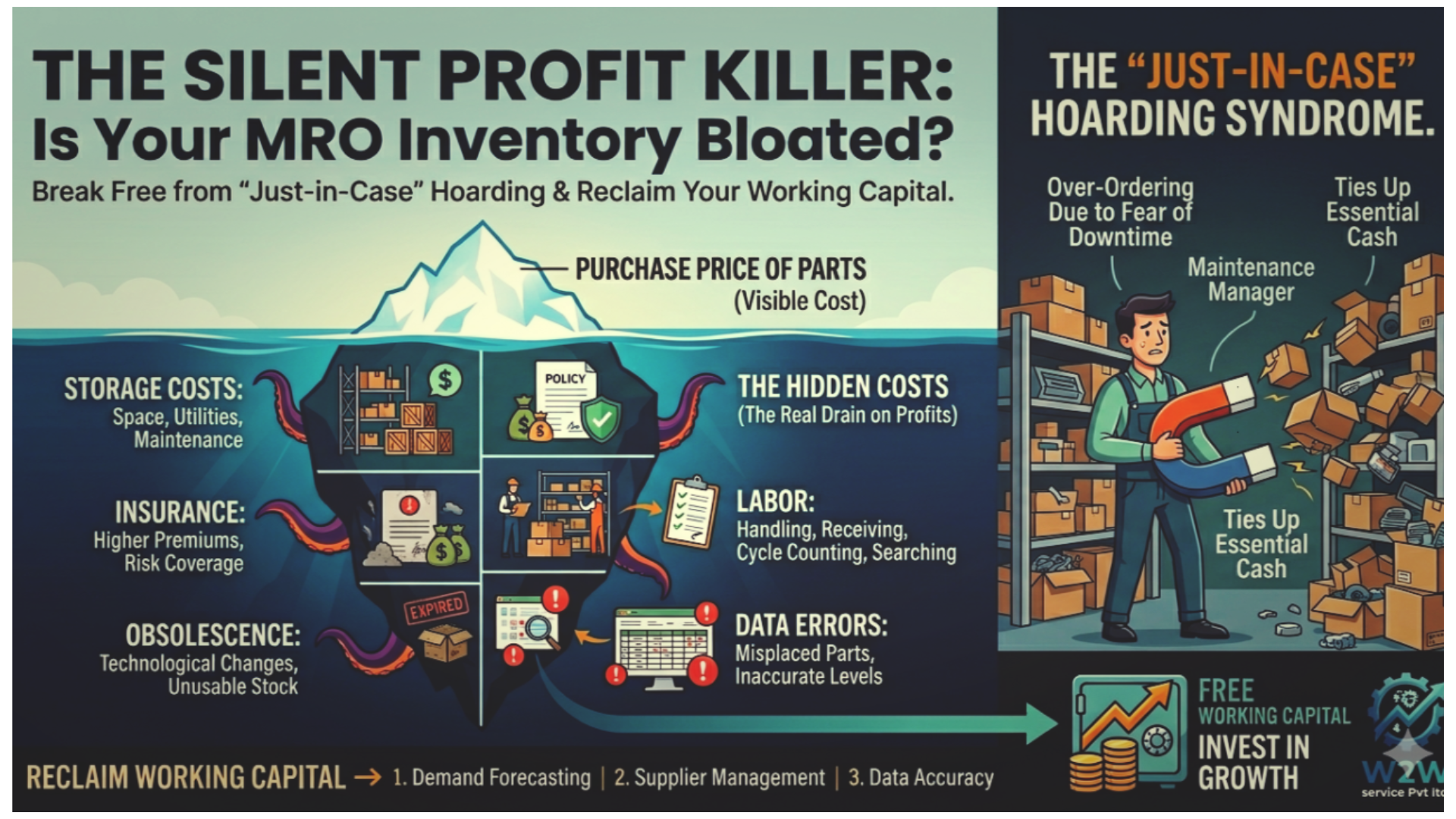
The Silent Profit Killer
Table of Contents
[ Show ]"Unlocking Working Capital, Space, and Operational Discipline in Process & Manufacturing Industries"
Introduction: The Hidden Cost Lying in Plain Sight
Across process industries and manufacturing organizations, Material, Repair, and Operations (MRO) inventory plays a vital role in safeguarding asset availability, ensuring production continuity, and supporting maintenance reliability. In asset-intensive environments, especially continuous process industries, MRO spares are procured as an insurance mechanism—intended to protect operations from costly downtime.
However, over time, this protective buffer often grows silently and uncontrollably. What begins as a reliability safeguard gradually transforms into a significant financial and operational burden, largely invisible to senior leadership.
In continuous process industries—from petrochemicals and power to pharmaceuticals, FMCG, and specialty chemicals—the mandate is unequivocal: zero unplanned downtime. This uncompromising focus on reliability drives organizations to stock MRO spares aggressively, often under a “better safe than sorry” philosophy. While operationally understandable, this mindset frequently results in a silent financial crisis—warehouses filled with MRO spares that will never be consumed during the asset lifecycle.
Excess, dead, and non-moving inventory remains one of the most under-addressed challenges in industrial supply chains. While management attention is rightly focused on production efficiency, procurement savings, and asset utilization, large volumes of unused and obsolete spares continue to occupy valuable warehouse space, block working capital, and distort ERP and SAP data. These inventories quietly accumulate over years, representing the compounded effect of overbuying, duplicate material creation, project closures, equipment obsolescence, conservative planning assumptions, and fragmented ownership across functions.
In many organizations, the problem is not the absence of data but the absence of structured intent. ERP systems faithfully record stock balances, yet fail to answer the most critical questions: Will this material ever be used again? Is this spare still technically relevant? Does its value justify its continued existence in inventory?
Industry studies and field experience consistently indicate that 30–50% of MRO inventory in large-scale manufacturing organizations qualifies as excess, non-moving, or dead stock. In absolute terms, this often translates into rupees crores of frozen working capital, hidden in plain sight—earning no return, consuming space, and silently eroding balance sheet efficiency.
This whitepaper presents a structured, practical roadmap for addressing this challenge. It explores how organizations can systematically identify, technically validate, reduce, and govern excess, dead, and non-moving MRO inventory without compromising operational reliability. Drawing on real-world experience across oil & gas, power, chemicals, pharmaceuticals, EPC, and heavy manufacturing sectors, the paper outlines proven approaches to converting dormant inventory into measurable financial and operational value—freeing capital, improving data integrity, and restoring discipline to MRO inventory management.
The Anatomy of MRO Waste: Understanding Excess, Dead, and Non-Moving Inventory
To solve any systemic problem, it must first be clearly defined. In MRO inventory management, one of the most persistent challenges is not the lack of data, but the lack of shared understanding. Industry leaders frequently use terms such as slow-moving, non-moving, and dead stock interchangeably, leading to misclassification, delayed decisions, and missed recovery opportunities.
Without clear definitions, organizations either hesitate to act—fearing operational risk—or take blunt actions that result in avoidable write-offs. A precise understanding of excess, non-moving, and dead inventory is therefore the foundation of any successful MRO inventory reduction initiative.
Excess inventory refers to stock quantities that exceed realistic operational or foreseeable consumption requirements. These materials are often technically usable and compliant, yet their volumes far surpass actual demand or justified safety stock levels. Excess inventory commonly accumulates due to bulk purchasing strategies, conservative safety stock assumptions, minimum order constraints, duplicate material codes across plants, or project-specific procurement that outlives the project itself. While not immediately problematic from a usability standpoint, excess inventory ties up working capital unnecessarily and increases storage, insurance, and handling costs.
Non-moving inventory represents a more concerning category. These are materials that have recorded zero consumption over a defined period—typically 12 to 24 months, depending on industry norms, equipment criticality, and operational context. Unlike slow-moving items, which may show sporadic or irregular usage, non-moving inventory exhibits no transactional movement whatsoever. This lack of activity often signals deeper structural issues such as equipment redundancy, outdated maintenance strategies, poor material master governance, or inadequate linkage between maintenance planning and inventory stocking. Left unaddressed, non-moving inventory steadily transitions into dead stock.
Dead inventory constitutes the most severe and value-destructive category of MRO waste. These are materials with no foreseeable future use due to equipment decommissioning, technology obsolescence, design changes, regulatory restrictions, vendor discontinuation, or physical deterioration over time. Dead stock frequently remains on organizational books for years, not because of operational need, but due to the absence of structured technical validation, ownership clarity, and formal disposal governance. The longer dead inventory remains unaddressed, the greater the financial distortion it creates in both inventory valuation and ERP reporting.
It is critical to recognize that excess and non-moving inventory is not inherently unusable. In many organizations, a significant portion of this stock can be recovered through systematic technical and operational review. With the right validation framework, materials can often be redeployed across plants, reused in alternate applications, returned to vendors, liquidated through approved channels, or monetized through secondary markets—thereby avoiding unnecessary write-offs and fresh procurement.
In practice, certain inventory categories are disproportionately affected. MRO spares, insurance spares, project leftovers, capital equipment components, obsolete assemblies, and residual spares from decommissioned or upgraded equipment account for the majority of excess and dead inventory in asset-intensive industries. These categories are particularly vulnerable in environments where project execution, maintenance, procurement, and stores operate in functional silos.
Understanding the anatomy of MRO waste is the first step toward reclaiming control. Only when inventory is accurately classified and technically understood can organizations move from passive accumulation to active reduction—without compromising reliability or asset availability.
Why Does the Bloat Happen?
The Systemic Roots of Excess, Non-Moving, and Dead MRO Inventory**
The accumulation of excess, non-moving, and dead MRO inventory is rarely the result of a single poor decision. Instead, it is the gradual outcome of multiple systemic gaps that compound over time across planning, procurement, maintenance, projects, and governance. Individually, these gaps may appear rational or even necessary. Collectively, they create a silent but persistent inventory bloat.
Poor Planning and “Just-in-Case” Overbuying
At the heart of MRO excess lies uncertainty. Unlike production materials, MRO consumption is irregular, failure-driven, and difficult to forecast with precision. To protect uptime and avoid emergency procurement, maintenance teams often request spares on a “just-in-case” basis. Procurement teams, in turn, purchase in economic order quantities or supplier-recommended packs, frequently without full lifecycle or criticality alignment.
The absence of consumption visibility and forward-looking demand planning inflates stocking decisions. Over time, safety buffers turn into excess, especially when equipment reliability improves, maintenance strategies change, or assets are modified. What began as risk mitigation slowly becomes capital blockage.
Duplicate Material Creation and Poor Master Data Discipline
Duplicate material records are one of the most underestimated contributors to MRO excess. The same spare part often exists under multiple material codes in ERP systems due to inconsistent naming conventions, incomplete technical descriptions, or lack of governance during material creation.
When duplicates exist, consumption gets fragmented across codes, masking true usage patterns. Procurement unknowingly replenishes parallel stocks of functionally identical items, while planners believe availability is low. Over years, these duplicates multiply across plants, projects, and warehouses—creating redundancy that is difficult to detect without structured data cleansing and technical validation.
Improper ROL Logic and Static Replenishment Rules
Reorder Level (ROL) logic that works for production materials often fails for MRO spares. MRO consumption is dynamic, asset-dependent, and influenced by maintenance strategies, equipment health, and operational maturity. Yet, in many organizations, ROLs are set once and rarely revisited.
Without periodic review, materials with declining relevance continue to auto-replenish, while spares with changing criticality remain incorrectly classified. In addition, unclear definitions of which MRO items genuinely require ROL-based replenishment further aggravate excess buildup. Tight governance, periodic consumption analysis, and clear classification rules are essential—but frequently missing.
Project Leftovers and EPC-Driven Procurement
Project-driven procurement is another major source of excess and dead inventory. During plant expansions, shutdowns, revamps, or EPC-led initiatives, materials are procured aggressively to avoid schedule risk. The priority is availability, not optimization.
Once projects are completed, modified, or cancelled, leftover materials often fall outside routine operational planning. These spares are rarely reviewed, reclassified, or redeployed. Instead, they remain stranded in stores—technically usable but operationally orphaned—slowly aging into non-moving and eventually dead stock.
Lack of Governance Over Obsolescence and Lifecycle Changes
Equipment obsolescence, vendor discontinuation, regulatory changes, and technology upgrades continuously alter spare part relevance. However, most organizations lack a formal workflow to periodically review spares against asset lifecycle status.
Without structured obsolescence reviews, spares for retired or modified equipment continue to sit in inventory indefinitely. In the absence of defined approval mechanisms for disposal or monetization, these materials remain untouched—distorting inventory valuation and ERP accuracy year after year.
Defensive SOPs and Risk-Averse Practices
In many organizations, MRO policies are designed primarily to safeguard maintenance teams from downtime risk. While well-intentioned, this often leads to overly conservative practices—such as classifying spares as insurance or capital items without rigorous technical justification.
In extreme cases, incorrect practices emerge: non-moving spares are reclassified as capital spares, zero-value materials remain physically stocked, or spares are issued to shop floors merely to show consumption. These actions may temporarily protect KPIs or audit positions, but they further obscure true inventory health and accelerate systemic inefficiency.
Diffuse Ownership and Accountability Gaps
Perhaps the most fundamental reason MRO inventory bloat persists is the lack of clear ownership. Warehouses store the material, maintenance requests it, procurement purchases it, finance carries it on the books—but no single function is accountable for its lifecycle optimization.
Without centralized ownership, inventory reduction initiatives struggle to gain traction. Excess remains unmanaged not because it is invisible, but because responsibility is fragmented. Until ownership is clearly defined and supported by governance, excess and dead inventory will continue to accumulate—quietly, predictably, and expensively.
The Journey from Silent Profit Killer to Reclaimed Working Capital
Transforming excess, non-moving, and dead MRO inventory into reclaimed working capital is not a single action—it is a structured journey. This journey begins with disciplined identification, moves through rigorous technical validation, and culminates in monetization, governance, and data sustainability. Organizations that succeed treat inventory reduction not as a finance-driven write-off exercise, but as a cross-functional operational transformation.
Data Mining and Analytical Identification: Where the Journey Begins
Effective inventory reduction starts with data—but data alone is never enough.
ERP and SAP systems provide a critical foundation by revealing consumption history, last issue dates, stock aging, and cumulative inventory value. These indicators help surface materials with zero or negligible movement over defined periods, typically 12 to 24 months depending on industry norms and asset criticality. Such analysis establishes an objective, quantitative baseline and highlights where working capital is potentially locked.
However, ERP data reflects transactions, not intent or future relevance. Therefore, analytical identification must be layered with operational context. Criticality assessments evaluate whether a material supports safety, statutory compliance, or production-critical equipment. Future demand analysis considers maintenance philosophies, asset health, shutdown plans, modernization programs, and decommissioning schedules.
Segmentation further sharpens focus. By analyzing inventory plant-wise, store-wise, and category-wise, organizations avoid treating inventory as a homogeneous pool and instead concentrate on high-impact areas—such as insurance spares, project leftovers, or high-value MRO categories. Duplicate material analysis uncovers hidden excess created through inconsistent master data practices, often revealing parallel stocks of functionally identical items that were never visible through consumption reports alone.
Physical verification plays a decisive role at this stage. ERP records frequently fail to reflect actual quantity, condition, or accessibility. Materials may be damaged, incomplete, missing, or stored outside system visibility. Physical checks validate existence and usability, ensuring that decisions are based on reality—not assumptions.
Together, data mining, analytical segmentation, and physical verification convert raw inventory data into a credible, decision-ready inventory landscape.
Technical and Operational Validation: Protecting Reliability While Unlocking Value
In MRO environments, inventory reduction cannot be driven by finance or analytics alone. Technical validation is essential to protect operational reliability.
Maintenance and reliability teams play a central role in validating whether identified excess or non-moving items may still be required in the future. Insurance spares are evaluated against equipment life expectancy, failure probability, replacement lead times, OEM support availability, and availability of functional substitutes. This ensures that risk is managed scientifically rather than emotionally.
Obsolete equipment spares are reviewed in the context of current asset status, modernization roadmaps, and decommissioning plans. In many organizations, spares remain stocked years after equipment has been replaced, mothballed, or permanently shut down—simply because no formal validation mechanism exists.
Poorly described, unidentified, or ambiguous materials undergo technical assessment and reclassification. Often, items previously marked as unusable are found to be functionally equivalent to active spares once descriptions are corrected and grouped appropriately. This step alone frequently unlocks significant reuse and redeployment potential.
Through structured validation workshops, cross-functional reviews, and physical inspections, organizations gain confidence to differentiate between reusable excess inventory and true dead stock—minimizing operational risk while maximizing value recovery.
Reduction and Disposal Strategies: Turning Dormant Stock into Business Value
Once inventory is technically validated, the focus shifts from identification to monetization and space recovery. Effective reduction follows a clear hierarchy of actions, always prioritizing value retention.
Redeployment is the first and preferred strategy. Excess inventory can often be moved across plants, units, or sister facilities within the same organization. This eliminates fresh procurement, reduces lead times, and directly releases working capital while strengthening internal supply resilience.
Vendor return and buy-back options are evaluated next. For unused or “new-in-box” spares, especially standard or high-value items, contractual clauses and supplier relationships may allow returns or buy-backs. Even partial recoveries represent immediate financial and storage benefits.
Liquidation and resale are explored for materials with external market demand but no internal requirement. Approved industrial resale channels, auctions, or authorized buyers convert dormant assets into cash while maintaining regulatory and audit compliance.
Scrapping remains the last resort, reserved for items that are obsolete, damaged, or non-compliant. Even here, structured documentation, approvals, and traceability ensure alignment with audit and statutory requirements.
Decisions between reuse, resale, and disposal are guided by material condition, internal demand, compliance obligations, and cost-benefit analysis—ensuring outcomes that are both financially and operationally sound.
ERP, SAP, and Data Integrity: Preventing Re-Accumulation
Inventory reduction delivers its full value only when system data is corrected and controlled.
Identified excess and dead materials are tagged, blocked, or reclassified in ERP and SAP systems to prevent further procurement. Material status updates, deletion flags, and planning parameter corrections ensure that future MRP runs reflect true operational needs rather than historical clutter.
Equally important is master data cleanup. Duplicate and inactive material codes are identified and eliminated, followed by data enrichment to complete technical attributes. Standardization of descriptions, units of measure, and classification structures significantly improves data accuracy and usability.
This cleanup is especially critical before ERP upgrades, SAP migrations, or digital transformation initiatives. Clean inventory data reduces transition risk, accelerates system adoption, and improves trust in analytics and reporting.
With clutter removed, ERP reports become meaningful tools for decision-making across maintenance, procurement, and finance—rather than repositories of historical noise.
Governance and Sustainability: Making Reduction a Discipline, Not a Project
Sustainable inventory reduction requires governance, not one-time cleanup.
Clear definitions for insurance spares, structured approval workflows for new MRO purchases, and periodic non-moving inventory reviews prevent re-accumulation. Integration with broader MRO optimization, reliability engineering, and asset management programs ensures alignment with long-term operational strategy.
Inventory reduction can be executed as a focused project or embedded as a recurring discipline, depending on organizational maturity. In either case, ownership, accountability, and cross-functional alignment are essential.
Audit readiness and documentation remain integral throughout the process. Proper records support financial write-offs, statutory compliance, and management reviews—ensuring transparency and credibility.
Ultimately, organizations that institutionalize governance convert inventory reduction from a corrective exercise into a continuous source of working capital release and operational excellence.
Financial, Operational, and Strategic Benefits: Turning Inventory Reduction into Measurable ROI
The impact of excess, dead, and non-moving MRO inventory reduction extends far beyond warehouse cleanup. When executed systematically, it delivers measurable financial returns, strengthens operational resilience, and elevates organizational governance maturity.
Financial Impact: Releasing Locked Working Capital
One of the most immediate and visible outcomes of inventory reduction is the release of blocked working capital. Excess and non-moving MRO inventory represents capital that has already been spent but delivers no productive return. By eliminating, redeploying, or monetizing unused stock, organizations convert dormant assets back into liquidity.
As inventory levels normalize, inventory turnover ratios improve—strengthening balance sheet health and enhancing financial transparency. For capital-intensive industries, this improvement directly supports cash flow optimization, improves return on capital employed (ROCE), and positively influences investor and lender confidence.
In many large manufacturing environments, the value unlocked through structured MRO inventory reduction runs into crores of rupees—often without any additional capital investment.
Operational Benefits: Improving Reliability While Reducing Cost
Contrary to common perception, inventory reduction does not increase operational risk when executed correctly. In fact, it improves reliability.
By removing clutter and redundant stock, warehouses become more organized, accessible, and accurate. Maintenance teams gain faster access to the right spares, reducing search time, emergency procurement, and work-order delays. Improved spare availability planning ensures that critical materials are available when required—directly supporting uptime and asset reliability.
At the same time, carrying costs decline significantly. Storage space requirements reduce, handling effort drops, insurance exposure decreases, and the risk of damage or deterioration is minimized. Obsolescence losses—which silently erode value year after year—are proactively eliminated instead of being discovered during audits or write-offs.
Procurement Discipline and Demand Visibility
Inventory reduction fundamentally improves procurement behavior.
As excess and duplicate materials are identified and controlled, unnecessary purchases are prevented. Clean master data, corrected planning parameters, and blocked obsolete materials ensure that procurement decisions are based on actual operational demand—not historical noise or fragmented data.
This improved visibility promotes disciplined buying, reduces maverick procurement, and strengthens negotiations with suppliers. Over time, organizations move away from reactive, “just-in-case” purchasing toward planned, data-driven procurement aligned with asset strategies.
Measurable ROI and Business Case Clarity
Perhaps the most compelling benefit of structured MRO inventory reduction is that its financial impact is measurable and defensible.
Return on investment is quantified through multiple levers:
- Avoided future procurement
- Reduced carrying and warehousing costs
- Monetization of surplus stock
- Downtime avoidance through better spare availability
- Improved audit and compliance outcomes
When reduction initiatives are executed with proper data analysis, technical validation, and governance, ROI often exceeds initial expectations—because hidden inefficiencies are uncovered and corrected across the inventory lifecycle.
Strategic Impact: Governance Maturity and Long-Term Sustainability
Beyond immediate cost and cash benefits, inventory reduction signals a shift in organizational maturity.
Clear ownership, defined approval workflows, periodic reviews, and ERP-integrated controls transform inventory management from a transactional function into a governed business discipline. Decision-making becomes proactive rather than corrective, and accountability replaces ambiguity.
Over time, organizations that institutionalize these practices achieve sustainable inventory control, improved data credibility, and stronger alignment between maintenance, procurement, finance, and operations.
In this sense, MRO inventory reduction is not merely a cost-saving initiative—it is a strategic enabler of operational excellence, financial resilience, and long-term competitiveness.
When Should Organizations Act?
Recognizing the Right Time for MRO Inventory Reduction
Organizations often delay addressing excess, dead, and non-moving MRO inventory because the impact is not immediately visible on the shop floor. However, clear warning signals consistently indicate when action is both necessary and value-accretive.
Excess inventory reduction should be initiated when inventory values rise disproportionately compared to production output or asset base growth, and when inventory turnover ratios begin to decline. Persistent warehouse congestion, increasing storage costs, and growing volumes of long-aged stock are strong indicators that inventory health has deteriorated.
Critical trigger points also arise during organizational or operational transitions. Project closures, plant shutdowns or restructuring, mergers and acquisitions, and ERP or SAP upgrades frequently expose large volumes of stranded and duplicate inventory. Addressing excess and dead stock during these phases not only releases capital but also prevents inefficiencies from being embedded into new operating models or digital systems.
For multi-plant organizations, the case for action is even stronger. Enterprise-wide visibility enables cross-plant reuse, redeployment, and consolidation—unlocking value that remains hidden when inventory is managed in silos. Centralized governance combined with local operational flexibility ensures that materials are available where needed, without unnecessary duplication across sites.
Industries with high asset intensity and complex maintenance requirements stand to gain the most from structured inventory reduction initiatives. Oil & gas, power, chemicals, pharmaceuticals, EPC, heavy engineering, and large-scale manufacturing environments typically carry deep MRO portfolios with long lifecycles, insurance spares, and project-driven materials. In these sectors, even small percentage improvements translate into significant financial and operational gains.
Conclusion: Turning Dormant Inventory into Strategic Value
Excess, dead, and non-moving MRO inventory is not merely a warehouse issue—it is a strategic opportunity hidden in plain sight.
When approached systematically, inventory reduction becomes a powerful lever for releasing working capital, improving operational discipline, strengthening ERP data integrity, and enhancing organizational resilience. The key lies in combining robust data analytics with technical validation, operational insight, and sustained governance.
Organizations that treat inventory reduction as a one-time cleanup often see short-lived benefits. Those that embed it as a structured, governed discipline realize lasting value—financially, operationally, and strategically.
The Way Forward: Building a Sustainable MRO Inventory Reduction Program with W2W
At W2W Services Pvt. Ltd., we partner with organizations to move beyond one-time inventory cleanups and establish a sustainable, governed approach to MRO inventory management. Our focus is not only on reducing excess, dead, and non-moving inventory—but on ensuring that the problem does not recur.
Our approach integrates engineering expertise, ERP and SAP alignment, and on-ground execution, enabling organizations to recover value without compromising operational reliability. Each engagement is designed to deliver measurable, auditable, and sustainable outcomes, aligned with both operational and financial objectives.
With over 10 years of deep domain experience in MRO inventory management, W2W has successfully executed 25+ large-scale projects across asset-intensive industries. To date, we have cleansed, validated, and optimized more than 6 lakh material master records, helping customers achieve 15–30% value addition through working capital release, inventory reduction, and procurement avoidance.
W2W’s Structured Inventory Reduction Framework
Drawing from practical, on-site experience, W2W has developed specialized frameworks and digital enablers to support organizations at every stage of their inventory reduction journey:
- Material Master Data Quality Health Check A structured assessment to identify duplicate, incomplete, and inconsistent material records that drive hidden excess and procurement inefficiencies.
- Inventory Health Check by DOSS Cycle (Data – Operations – Stock – System) A holistic diagnostic model that evaluates inventory health across data quality, maintenance practices, physical stock, and ERP/SAP controls—ensuring root causes are addressed, not just symptoms.
- ClenzMat Pro™ – Master Data Cleansing & Governance Platform A purpose-built application to support large-scale data cleansing, enrichment, standardization, and long-term master data governance—ensuring sustained data quality beyond the project phase.
- SpareFusion Platform A structured channel for liquidating excess, dead, non-moving, and slow-moving inventory through compliant resale, reuse, or monetization routes.
- On-Site Technical Data Collection Services Specialized field teams to convert project leftover materials into structured material master records and capture missing technical attributes for poorly described spares.
- Stock Reconciliation & Accuracy Analysis Physical verification and system reconciliation to validate stock accuracy and eliminate ghost inventory.
- Stores Process Audits & SOP Improvement Assessment and redesign of stores operations, material handling, and inventory governance processes.
- Vendor Consolidation & Rationalization Services Reducing supplier complexity while improving standardization, availability, and cost control.
From Reactive Inventory to Proactive Value Creation
By transforming dormant inventory into reclaimed capital and disciplined processes, organizations can shift from reactive inventory management to proactive value creation. W2W’s methodology ensures that inventory reduction is not a one-time exercise, but a repeatable, governed capability embedded within the organization.
Whether supporting ERP transitions, multi-plant operations, or asset-intensive maintenance environments, W2W helps organizations unlock hidden value—while strengthening reliability, transparency, and long-term control.